
Language access in education is not a supplemental service or a discretionary accommodation. It is a foundational requirement for equitable instruction, student participation, and institutional compliance. For Deaf and hard-of-hearing students, educational interpreting is one of the primary mechanisms through which that access is delivered.
Yet educational interpreting is often misunderstood. It is frequently reduced to a staffing decision, treated as a reactive accommodation, or evaluated only by whether an interpreter is physically present. This framing overlooks what educational interpreting actually represents: a regulated, high-responsibility language access function that directly affects student outcomes, legal defensibility, and trust in the education system.
This guide is written for school administrators, compliance officers, and program leaders who are responsible for designing, overseeing, or defending language access in educational environments. It moves beyond surface definitions to explain how educational interpreting functions in practice, why it must be treated as infrastructure, and what institutions are accountable for when these services are required.

What an Educational Interpreter Does in an Educational Setting
An educational interpreter is a trained professional who facilitates communication access for Deaf or hard-of-hearing students within educational environments. Their role is to interpret spoken language into a visual language, such as American Sign Language or another signed communication system, and to voice the student’s signed communication back into spoken English for educators, staff, and peers.
At its core, educational interpreting enables students to access instruction, engage in classroom dialogue, and participate meaningfully in the academic and social life of a school. The interpreter’s responsibility is accuracy, neutrality, and consistency. They convey meaning as it is expressed, without adding, omitting, or modifying content.
This distinction matters. Educational interpreters are not educators, tutors, or instructional aides. They do not explain lessons, simplify material, or assess comprehension. Their role is to provide communication access so that instruction can occur, not to deliver instruction themselves.
In education, communication is cumulative. Students build knowledge over time, often across multiple subjects, grade levels, and instructional formats. Even small lapses in interpretation can have compounding effects on comprehension and engagement. This is why educational interpreting must be viewed as an ongoing access function rather than a one-time service.
Where Educational Interpreting Happens, and Why Context Matters
Educational interpreting does not occur in a single, controlled environment. It spans the full range of instructional and school-related settings where learning and participation take place.
These environments commonly include:
- Daily classroom instruction across academic subjects
- Small group discussions and collaborative work
- School assemblies and presentations
- Field trips and experiential learning activities
- Extracurricular programs, clubs, and athletics
- Informal instructional moments throughout the school day
- Individualized Education Program meetings and related planning conversations
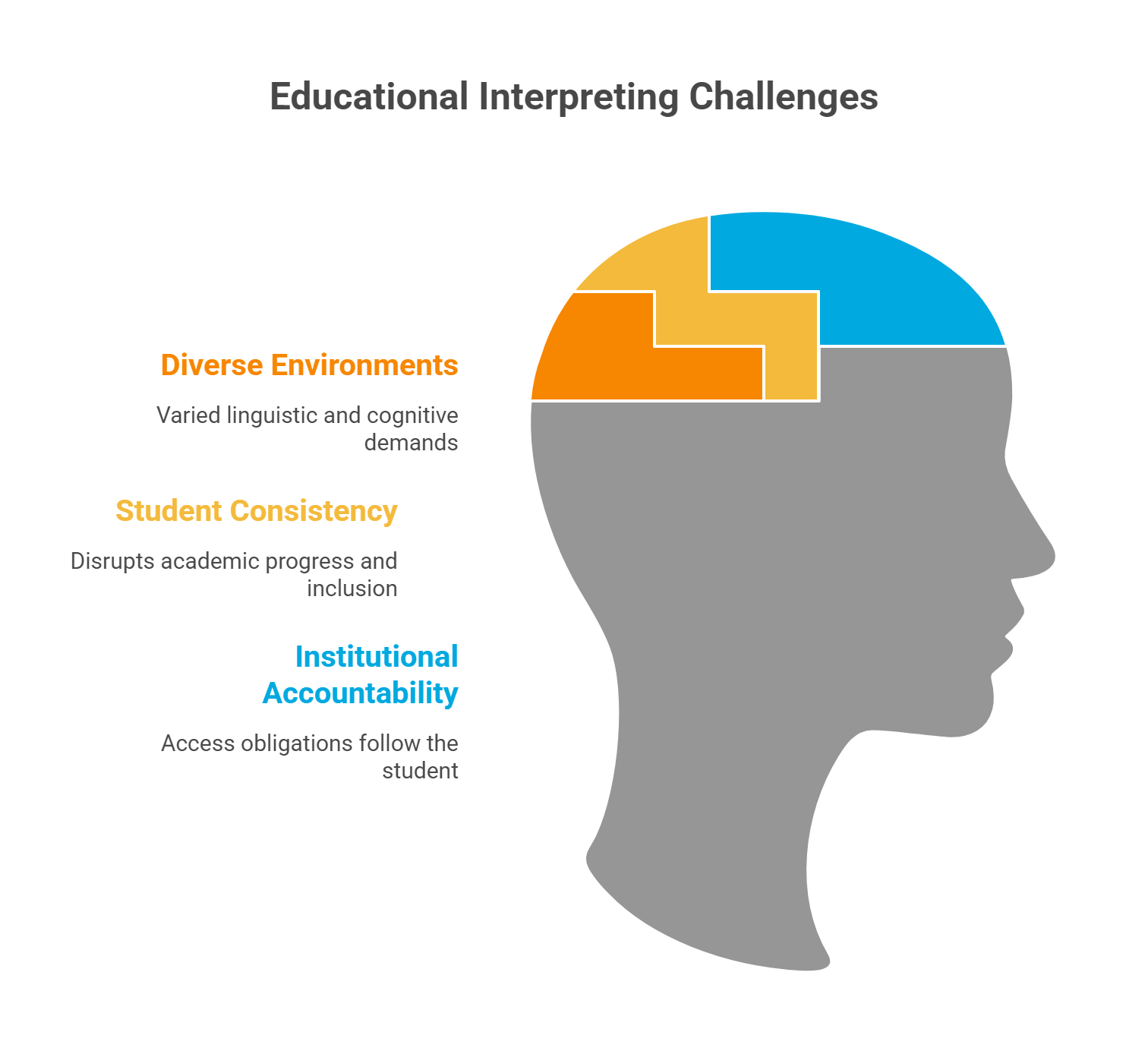
Each setting presents different linguistic and cognitive demands. A science lecture may require preparation for technical terminology and rapid information flow. A classroom discussion may require careful interpretation of tone, intent, and peer interaction. A field trip may involve environmental noise, movement, and unplanned communication.
From a student perspective, consistency across these contexts is essential. Fragmented coverage, frequent interpreter changes, or gaps during non-classroom activities disrupt continuity and can undermine both academic progress and social inclusion.
From an institutional perspective, these environments represent points of accountability. Educational access does not end when the bell rings or when instruction moves outside the classroom. Language access obligations follow the student across the full scope of the educational experience.
Educational Interpreter vs. Other Support Roles in Schools
One of the most persistent sources of risk in educational interpreting is role confusion. Interpreters work alongside teachers, aides, counselors, and administrators, but their role is distinct and intentionally bounded.
An educational interpreter is not a tutor. They do not reinforce lessons, assist with assignments, or provide academic guidance. They are not classroom aides responsible for managing behavior, redirecting attention, or supporting task completion.
They are also not advocates or decision-makers. While interpreters may participate in meetings as members of the educational team, their professional ethics require neutrality. They facilitate communication, but they do not speak on behalf of the student or influence educational decisions.
In some schools, bilingual staff or family members are used to bridge communication gaps. While this may appear practical, it introduces serious concerns. These individuals are typically not trained in interpretation techniques, confidentiality standards, or ethical boundaries. This can lead to miscommunication, breaches of privacy, and inconsistent access.
Clear role definition protects everyone involved. Students receive professional, reliable access. Interpreters can work within ethical guidelines. Schools reduce the likelihood of complaints, disputes, and defensibility challenges related to miscommunication or inappropriate role expectations.

Qualifications and Competency in Educational Interpreting
Educational interpreting requires more than language fluency. It demands a specialized set of skills tailored to instructional environments, developmental stages, and the pace of academic communication.
Competent educational interpreters must be able to process complex information in real time while maintaining accuracy and neutrality. They need familiarity with educational terminology, classroom dynamics, and the cognitive demands placed on students at different grade levels.
Across the United States, various assessments and credentials are commonly referenced as indicators of interpreter competence. These include tools such as the Educational Interpreter Performance Assessment and certifications associated with the Registry of Interpreters for the Deaf. These credentials can provide valuable insight into baseline skills, but they are not guarantees of ongoing quality.
What matters most is demonstrated competence within the specific educational context. This includes alignment with a student’s preferred communication mode, readiness for subject-specific content, and the ability to collaborate professionally with educators without crossing role boundaries.
Quality assurance in educational interpreting is not static. It requires ongoing evaluation, feedback, and professional development. Curricula change, student needs evolve, and instructional methods shift over time. A program that treats competency as a one-time requirement risks falling behind the realities of the classroom.
Why Educational Interpreting Is a Compliance and Access Issue
Educational interpreting is fundamentally about access. When students cannot fully access instruction due to communication barriers, the impact extends beyond individual lessons. It affects participation, assessment, social development, and long-term educational outcomes.
For institutions, this makes educational interpreting both an equity issue and a compliance issue. Schools and agencies are responsible not only for planning access, but for delivering it consistently and effectively.
Ad hoc approaches create risk. Informal coverage, inconsistent scheduling, or reliance on unqualified individuals can result in documented plans that are not matched by actual access. In these situations, documentation alone offers limited protection if access breaks down in practice.
Treating educational interpreting as infrastructure changes this dynamic. Infrastructure is designed intentionally. It is staffed, monitored, and adjusted as conditions change. It is expected to function reliably, even when disruptions occur.
This mindset supports both students and institutions. Students experience consistent, dignified access. Institutions gain clearer visibility into service delivery and stronger defensibility when questions arise.

What a Well-Run Educational Interpreting Program Looks Like
Effective educational interpreting does not happen by chance. It is the result of intentional program design that accounts for daily instructional needs as well as inevitable disruptions.
A well-run educational interpreting program typically includes:
- Planned coverage models aligned with instructional schedules
- Continuity planning to support consistent access over time
- Backup and escalation processes for absences, schedule changes, or urgent needs
- Clear role definitions communicated to staff, students, and interpreters
- Quality monitoring and feedback mechanisms
- Transparent tracking of service fulfillment and coverage
This programmatic approach reduces operational strain. Administrators are not forced into reactive decision-making. Interpreters are supported by clear expectations and workflows. Students experience fewer disruptions and greater continuity.
Importantly, this approach also enables continuous improvement. When performance is tracked and feedback is gathered, institutions can identify gaps early and make informed adjustments before issues escalate.
Common Challenges Schools Face, and How to Address Them
Even well-designed programs face challenges. Interpreter availability can be limited in certain regions or for certain communication modes. Student-specific needs may change over time, requiring different skill matches. Schedules shift, staff are absent, and special events arise with little notice.
Without structure, these challenges can quickly lead to access gaps. Without escalation paths, small disruptions become systemic problems.
Addressing these realities requires both flexibility and planning. Hybrid delivery models may support continuity during disruptions when appropriate. Proactive recruitment and preparation help mitigate shortages. Clear communication channels ensure that issues are addressed promptly.
Most importantly, programs must be designed with the expectation that challenges will occur. Resilience is built through preparation, not reaction.
Educational Interpreting as Part of a Broader Language Access Strategy
Educational interpreting does not operate in isolation. Many institutions serve multilingual communities across education, healthcare, social services, and public programs.
When educational interpreting is aligned within a broader language access strategy, consistency improves. Standards are shared. Reporting is centralized. Oversight becomes clearer.
This integration reduces fragmentation and supports better outcomes across departments. It also reinforces the principle that language access is not a series of disconnected services, but a core operational function that benefits from coordination and planning.
Moving Forward with Confidence
Educational interpreting is most effective when it is intentional. Clear roles, qualified professionals, and structured programs create environments where students can learn confidently and institutions can operate with clarity and accountability.
Language access in education is not about checking a box. It is about ensuring that communication barriers do not become educational barriers. When educational interpreting is treated as infrastructure, rather than as an afterthought, it supports equity, compliance, and trust.
Schools and agencies do not need to navigate this complexity alone. With thoughtful planning and the right support, educational interpreting can function as reliable, dignified access that serves students and institutions alike.

Strengthening Language Access in Education
Educational interpreting works best when it is part of a broader, intentional language access strategy. Clear roles, qualified interpreters, and reliable delivery models help schools and agencies move beyond reactive accommodations toward sustainable, defensible access.
At Geneva Worldwide, we support educational institutions as a long-term language access partner. Our approach treats language access as infrastructure, designed with compliance, continuity, and dignity in mind. We help schools and agencies plan, deliver, and monitor interpreting services across instructional settings, events, and programs, so access remains consistent even as needs evolve.
If your organization is evaluating how educational interpreting fits into a larger access framework, or if you are working to strengthen consistency, coverage, or compliance across programs, we invite you to explore our resources:
- Learn more about Geneva Worldwide’s approach to professional interpretation services, including on-site, remote, and scalable delivery options:
https://www.genevaworldwide.com/services/interpretation/ - Visit Geneva Worldwide to explore how we support public agencies, healthcare systems, and education partners nationwide through human-centered, compliance-minded language access solutions.
- Explore our upcoming Language Access in Education pillar resource, designed to help education leaders understand how interpreting, planning, and program design work together to support equitable access and stronger outcomes.
Language access in education is complex, but it does not have to be fragmented. With the right structure and support, it becomes a reliable foundation for learning, inclusion, and trust.
